Review
Review
Exploring The State of Street Dance in Aotearoa
Exploring The State of Street Dance in Aotearoa
Exploring The State of Street Dance in Aotearoa
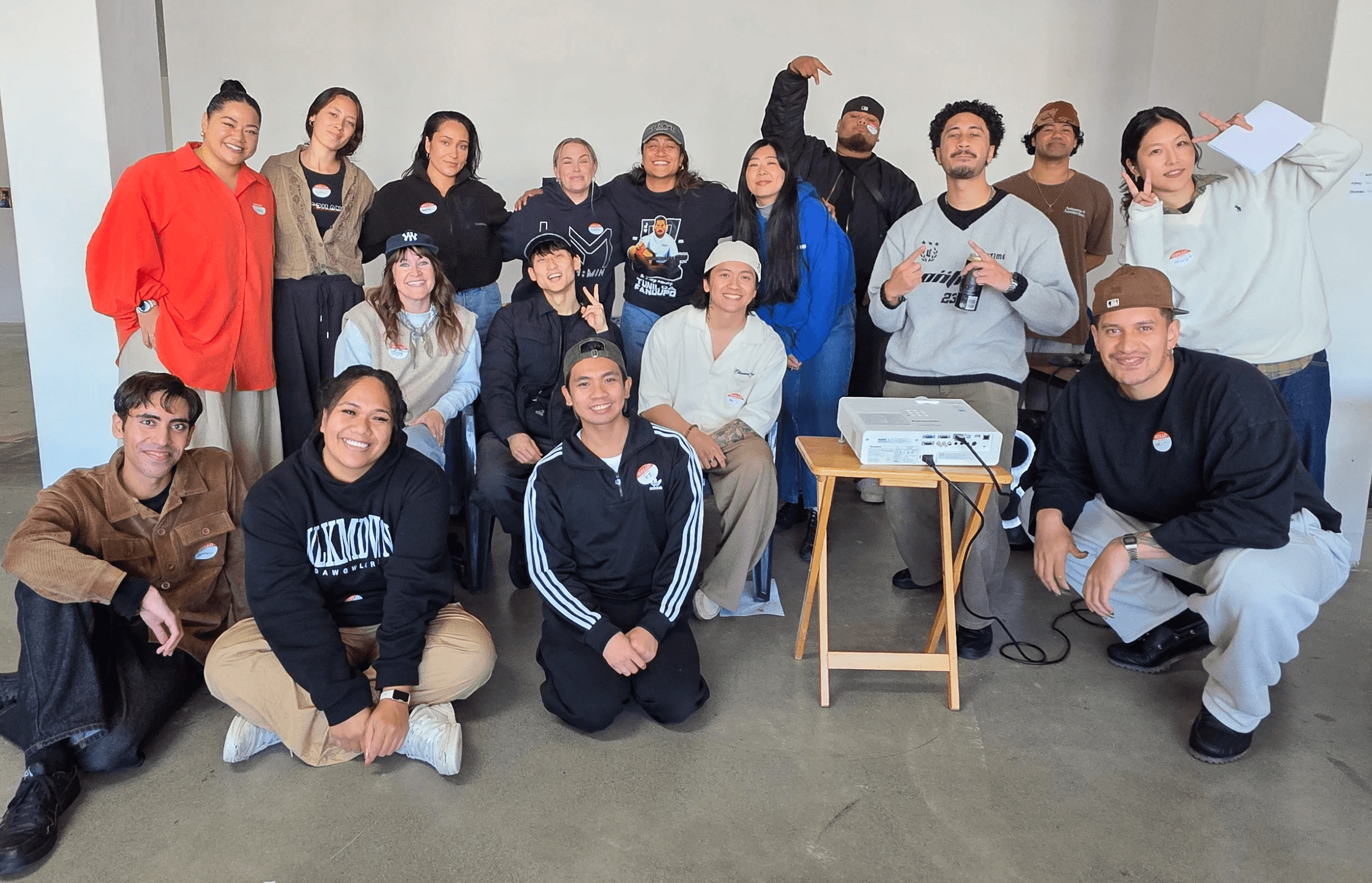
Food, fun and whanaungatanga… What more could you want on a Sunday morning?
When Projekt Team put out the word that they were holding a workshop diving into ‘The State of Street Dance in Aotearoa,’ I knew it was something I couldn’t miss. The invitation was open to everyone on Instagram, with an accessible online option for contributions, so of course I was naturally curious to see who would show up and what subjects would be broached.
Arriving at the same time as some friends, we walked into the Taro Patch Creative space in Papatoetoe together. As we stepped through the doors, we were warmly greeted by Mele 1.0 (Mele Ta'e'iloa) and 2.0 (Mele Tapueluelu) before immediately diving into the incredible food provided by the team. The session was then opened by Mele 2.0 with a few words from Mele 1.0, which warmly set the tone: The workshop was designed as an opportunity to share our experiences, have our voices heard, and offer perspectives on what our scene needs in today’s world; perhaps even providing a chance to heal old wounds.
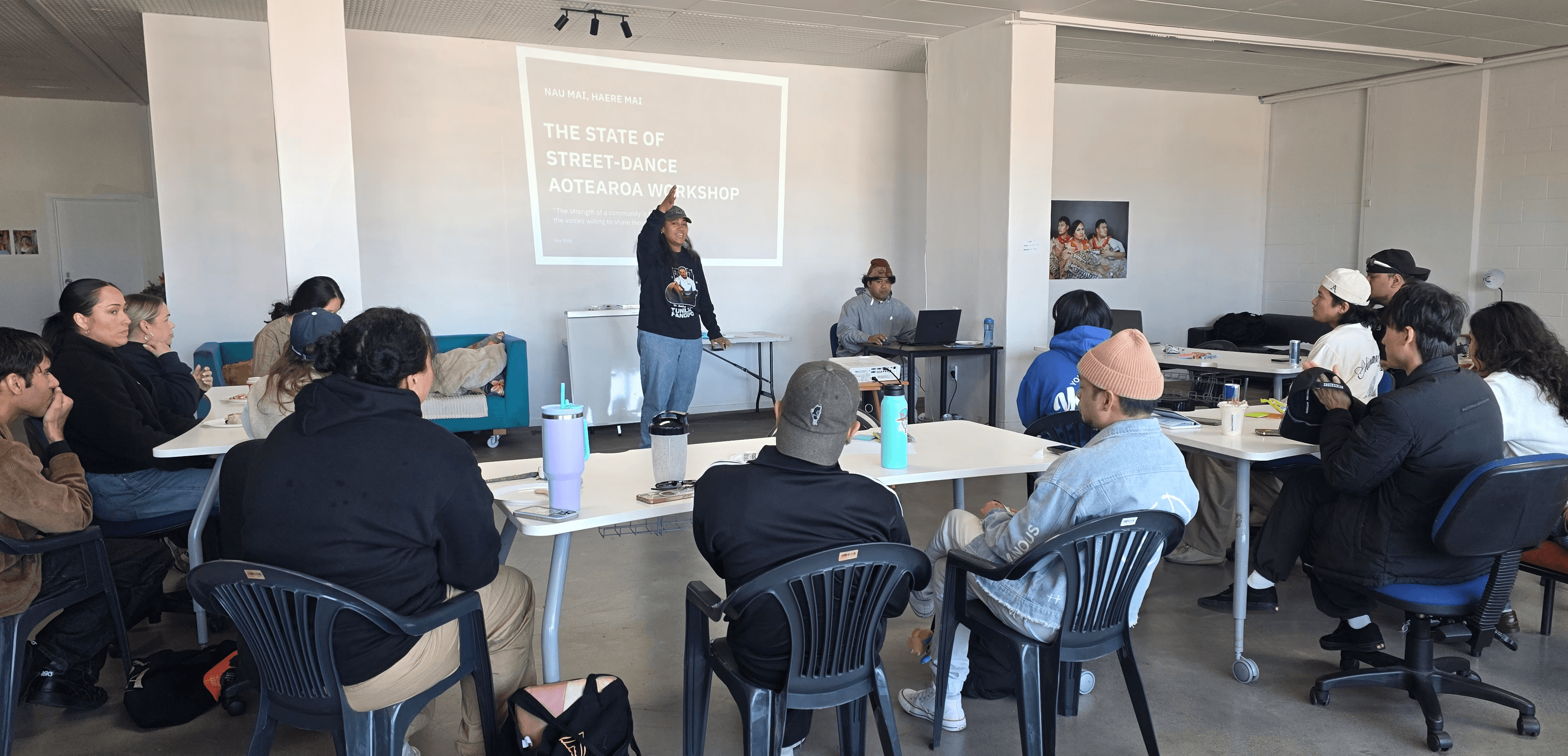
In the room there was representation covering almost all of the street dance style communities (Waacking, Campbellocking, House, Breaking, Krump, Hip Hop, Popping) and many Auckland crews and collectives. There was a great mix of generations present, alongside some who are newer to the Auckland scene. Elizabeth Fa’amausili-Atalili (Liz) facilitated the workshop, expertly guiding our discussions in a way that made everyone feel comfortable and supported. First, we did an art therapy style activity to reflect on our own journeys, think about the wider collective, and bring our visual interpretations of the scene to the surface. When we shared these with the wider group, it became obvious we have some seriously talented artists among us! The exercise provided much “clarity” on what others were experiencing and witnessing in their respective corners of the community.
Then came the real meaty part, where we dove into topics that could have easily sparked controversy or triggered our inner problem solvers to try and fix everything at once. Thankfully, it went much smoother than anticipated. Liz was a huge reason for that, guiding us through the activities and gently reminding us that we didn't have to solve anything that day; our job was just surfacing and sifting through these ideas together.
The prompts raised were: “We need less...", "We need more...", "Leaders and organisers can help by...", "I wish dance spaces...", "I want the community to feel...", "Future generations deserve...”.
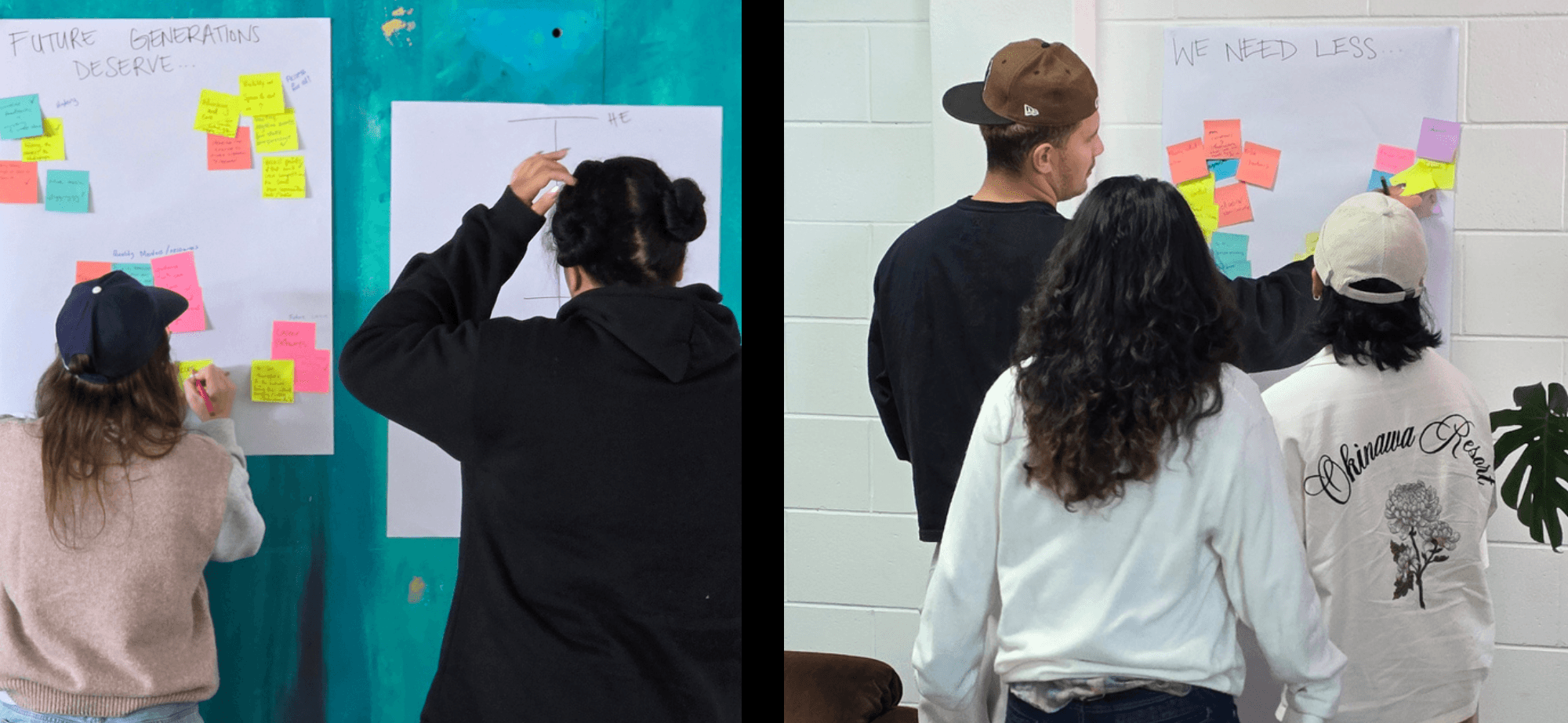
Diving into the ‘we need less’ category, it was evident that many of us have felt the painful effects of gossip and judgment, and that what we truly need is more affirmation and encouragement. This was one of those collectively shared moments that offered some healing, just from knowing we are all in the same waka.
There was also resounding agreement around the need for more resourcing: spaces, audiences, and funding. We are all feeling that pinch right now, navigating the difficult balancing act between creating art and survival.
There were more issues and ideas raised, and being the artists we are, we naturally needed more time to dive deeper while sorting these thoughts into achievable milestones (high effort to low effort). I would love to detail each outcome here, but you truly had to be in the room to understand the depth of what was said and felt, and how much stronger our connections feel after sharing space in community. I really loved hearing the voices I don’t always get to hear from and seeing others presenting their ideas and owning them. We are truly blessed with many intelligent, creative and open minds in this community.
I’d like to say a huge thank you to the Projekt Team for providing this opportunity to connect and converse - this is just another example of the team’s forward and community thinking. I look forward to reading the collation of ideas from both the workshop and the online submissions.
It makes me wonder: will the digital feedback mirror what was shared in person or will they be unrestrained/more restrained behind a keyboard? What could happen if we held ongoing Talanoa like this? Could regular catch ups help us dig deeper, build stronger community connections, and further develop our national identity? After all, nāu te rourou, nāku te rourou, ka ora ai te iwi (with your food basket and my food basket, the people will thrive). It also begs the question: who else was missing from the room that still needs to be heard?
So, I guess my final question is... who’s hosting the next one?
————
📝 Complete the Survey and Share Your Thoughts
Food, fun and whanaungatanga… What more could you want on a Sunday morning?
When Projekt Team put out the word that they were holding a workshop diving into ‘The State of Street Dance in Aotearoa,’ I knew it was something I couldn’t miss. The invitation was open to everyone on Instagram, with an accessible online option for contributions, so of course I was naturally curious to see who would show up and what subjects would be broached.
Arriving at the same time as some friends, we walked into the Taro Patch Creative space in Papatoetoe together. As we stepped through the doors, we were warmly greeted by Mele 1.0 (Mele Ta'e'iloa) and 2.0 (Mele Tapueluelu) before immediately diving into the incredible food provided by the team. The session was then opened by Mele 2.0 with a few words from Mele 1.0, which warmly set the tone: The workshop was designed as an opportunity to share our experiences, have our voices heard, and offer perspectives on what our scene needs in today’s world; perhaps even providing a chance to heal old wounds.
In the room there was representation covering almost all of the street dance style communities (Waacking, Campbellocking, House, Breaking, Krump, Hip Hop, Popping) and many Auckland crews and collectives. There was a great mix of generations present, alongside some who are newer to the Auckland scene. Elizabeth Fa’amausili-Atalili (Liz) facilitated the workshop, expertly guiding our discussions in a way that made everyone feel comfortable and supported. First, we did an art therapy style activity to reflect on our own journeys, think about the wider collective, and bring our visual interpretations of the scene to the surface. When we shared these with the wider group, it became obvious we have some seriously talented artists among us! The exercise provided much “clarity” on what others were experiencing and witnessing in their respective corners of the community.
Then came the real meaty part, where we dove into topics that could have easily sparked controversy or triggered our inner problem solvers to try and fix everything at once. Thankfully, it went much smoother than anticipated. Liz was a huge reason for that, guiding us through the activities and gently reminding us that we didn't have to solve anything that day; our job was just surfacing and sifting through these ideas together.
The prompts raised were: “We need less...", "We need more...", "Leaders and organisers can help by...", "I wish dance spaces...", "I want the community to feel...", "Future generations deserve...”.
Diving into the ‘we need less’ category, it was evident that many of us have felt the painful effects of gossip and judgment, and that what we truly need is more affirmation and encouragement. This was one of those collectively shared moments that offered some healing, just from knowing we are all in the same waka.
There was also resounding agreement around the need for more resourcing: spaces, audiences, and funding. We are all feeling that pinch right now, navigating the difficult balancing act between creating art and survival.
There were more issues and ideas raised, and being the artists we are, we naturally needed more time to dive deeper while sorting these thoughts into achievable milestones (high effort to low effort). I would love to detail each outcome here, but you truly had to be in the room to understand the depth of what was said and felt, and how much stronger our connections feel after sharing space in community. I really loved hearing the voices I don’t always get to hear from and seeing others presenting their ideas and owning them. We are truly blessed with many intelligent, creative and open minds in this community.
I’d like to say a huge thank you to the Projekt Team for providing this opportunity to connect and converse - this is just another example of the team’s forward and community thinking. I look forward to reading the collation of ideas from both the workshop and the online submissions.
It makes me wonder: will the digital feedback mirror what was shared in person or will they be unrestrained/more restrained behind a keyboard? What could happen if we held ongoing Talanoa like this? Could regular catch ups help us dig deeper, build stronger community connections, and further develop our national identity? After all, nāu te rourou, nāku te rourou, ka ora ai te iwi (with your food basket and my food basket, the people will thrive). It also begs the question: who else was missing from the room that still needs to be heard?
So, I guess my final question is... who’s hosting the next one?
————
📝 Complete the Survey and Share Your Thoughts
Food, fun and whanaungatanga… What more could you want on a Sunday morning?
When Projekt Team put out the word that they were holding a workshop diving into ‘The State of Street Dance in Aotearoa,’ I knew it was something I couldn’t miss. The invitation was open to everyone on Instagram, with an accessible online option for contributions, so of course I was naturally curious to see who would show up and what subjects would be broached.
Arriving at the same time as some friends, we walked into the Taro Patch Creative space in Papatoetoe together. As we stepped through the doors, we were warmly greeted by Mele 1.0 (Mele Ta'e'iloa) and 2.0 (Mele Tapueluelu) before immediately diving into the incredible food provided by the team. The session was then opened by Mele 2.0 with a few words from Mele 1.0, which warmly set the tone: The workshop was designed as an opportunity to share our experiences, have our voices heard, and offer perspectives on what our scene needs in today’s world; perhaps even providing a chance to heal old wounds.
In the room there was representation covering almost all of the street dance style communities (Waacking, Campbellocking, House, Breaking, Krump, Hip Hop, Popping) and many Auckland crews and collectives. There was a great mix of generations present, alongside some who are newer to the Auckland scene. Elizabeth Fa’amausili-Atalili (Liz) facilitated the workshop, expertly guiding our discussions in a way that made everyone feel comfortable and supported. First, we did an art therapy style activity to reflect on our own journeys, think about the wider collective, and bring our visual interpretations of the scene to the surface. When we shared these with the wider group, it became obvious we have some seriously talented artists among us! The exercise provided much “clarity” on what others were experiencing and witnessing in their respective corners of the community.
Then came the real meaty part, where we dove into topics that could have easily sparked controversy or triggered our inner problem solvers to try and fix everything at once. Thankfully, it went much smoother than anticipated. Liz was a huge reason for that, guiding us through the activities and gently reminding us that we didn't have to solve anything that day; our job was just surfacing and sifting through these ideas together.
The prompts raised were: “We need less...", "We need more...", "Leaders and organisers can help by...", "I wish dance spaces...", "I want the community to feel...", "Future generations deserve...”.
Diving into the ‘we need less’ category, it was evident that many of us have felt the painful effects of gossip and judgment, and that what we truly need is more affirmation and encouragement. This was one of those collectively shared moments that offered some healing, just from knowing we are all in the same waka.
There was also resounding agreement around the need for more resourcing: spaces, audiences, and funding. We are all feeling that pinch right now, navigating the difficult balancing act between creating art and survival.
There were more issues and ideas raised, and being the artists we are, we naturally needed more time to dive deeper while sorting these thoughts into achievable milestones (high effort to low effort). I would love to detail each outcome here, but you truly had to be in the room to understand the depth of what was said and felt, and how much stronger our connections feel after sharing space in community. I really loved hearing the voices I don’t always get to hear from and seeing others presenting their ideas and owning them. We are truly blessed with many intelligent, creative and open minds in this community.
I’d like to say a huge thank you to the Projekt Team for providing this opportunity to connect and converse - this is just another example of the team’s forward and community thinking. I look forward to reading the collation of ideas from both the workshop and the online submissions.
It makes me wonder: will the digital feedback mirror what was shared in person or will they be unrestrained/more restrained behind a keyboard? What could happen if we held ongoing Talanoa like this? Could regular catch ups help us dig deeper, build stronger community connections, and further develop our national identity? After all, nāu te rourou, nāku te rourou, ka ora ai te iwi (with your food basket and my food basket, the people will thrive). It also begs the question: who else was missing from the room that still needs to be heard?
So, I guess my final question is... who’s hosting the next one?
————
📝 Complete the Survey and Share Your Thoughts
Kat Walker Su’a Sagapolutele

Review
Sep 8, 2026
BEATDOWN: A Mum's Take
Read article
Review
Sep 8, 2026
BEATDOWN: A Mum's Take
Read article
Review
Sep 8, 2026
BEATDOWN: A Mum's Take
Read article

Review
Jul 26, 2026
Honest thoughts on An Honest Conversation
Read article
Review
Jul 26, 2026
Honest thoughts on An Honest Conversation
Read article
Review
Jul 26, 2026
Honest thoughts on An Honest Conversation
Read article
Review
Jul 2, 2026
WOOF x3: What The Dawgpound, Vol. III Revealed About the Scene
Read article
Review
Jul 2, 2026
WOOF x3: What The Dawgpound, Vol. III Revealed About the Scene
Read article
Review
Jul 2, 2026
WOOF x3: What The Dawgpound, Vol. III Revealed About the Scene
Read article